
Healthcare is supposed to be a sanctuary of healing, but in Delhi and the National Capital Region (NCR), a sinister nexus has turned parts of the medical supply chain into a game of profit at the cost of human lives. Recent investigative findings, Anti-Corruption Branch (ACB) actions, and major procurement scandals have exposed how fake, substandard, and siphoned medicines manage to creep not just into local chemist shops, but deep into government hospital supply chains through manipulated tenders.
This article explores the anatomy of this critical issue, shedding light on why cheap spurious drugs win government contracts, how the system gets bypassed, and what it means for ordinary citizens.
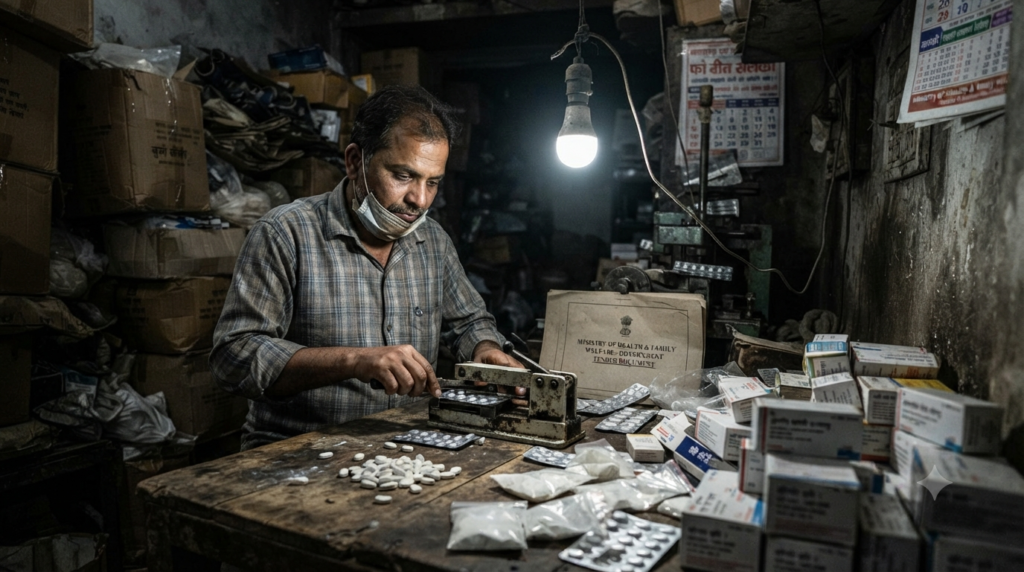
The Core Issue: Why Cheap, Fake Medicines Win Government Tenders
You might wonder: How can fake or substandard drug suppliers win official government tenders if strict protocols exist? The answer lies in a dangerous loophole built around cost-efficiency metrics.
- The Race to the Lowest Bidder (L1 System): In many traditional public procurement models, contracts are heavily skewed toward the lowest bidder (often referred to as the L1 criteria). Unscrupulous manufacturers and shell companies quote unrealistically low prices that legitimate, high-quality pharmaceutical brands simply cannot match.
- Cost Compromise on Raw Materials: Fake or substandard medicine makers cut corners drastically. They use little to no active pharmaceutical ingredients (API), replacing them with inert or harmful fillers like chalk powder, starch, or impure chemicals. Because their manufacturing cost is near zero, they can afford to underbid competitors while promising massive profit margins to corrupt middlemen.
- Falsified Documentation and Front Companies: Investigations into major procurement frauds in Delhi have repeatedly shown that shady suppliers set up fake front companies or use forged quality certificates and manipulated lab test reports to clear technical evaluation rounds. By the time authorities realize the documents are bogus, the supply orders have already been awarded.
Anatomy of the Scams: What Recent Investigations Reveal
The nexus between corrupt officials, private brokers, and fraudulent suppliers is deep-rooted. Recent developments highlight the alarming scale of medical procurement corruption in the capital:
- The Multi-Crore Procurement Scandals: High-profile probes by agencies like the Delhi Anti-Corruption Branch (ACB) and vigilance departments have uncovered massive irregularities worth hundreds of crores. Investigations into centralized procurement bodies revealed how prices of medical items, surgical consumables, and equipment were artificially inflated by hundreds of percent, while substandard or improperly vetted items entered the inventory.
- Diversion of Genuine Government Stock: It is not just about manufacturing fake drugs; active racketeering also involves stealing genuine medicines meant for free distribution in government hospitals and pumping them back into the open market. For instance, Delhi Police unmasked rings where hospital staff and pharmacists colluded to siphon off government-supply drugs (stamped “Govt Supply, Not for Sale”) into commercial distribution channels.
- Substandard Quality Clearance: Drugs failing standard quality control tests—lacking potency or containing toxic impurities—have repeatedly found their way into institutional healthcare networks through opaque bidding processes.
The Direct Impact on Common Citizens
When corruption dictates who wins a medical tender, the ultimate victim is the common man—especially the underprivileged who rely entirely on government hospitals, dispensaries, and welfare clinics.
- Treatment Failure: A patient consuming a fake antibiotic or a diluted lifesaving drug gets zero therapeutic value. Instead of curing an infection, the disease worsens, leading to prolonged suffering or fatal outcomes.
- Loss of Trust in Public Healthcare: When government hospitals dispense ineffective medicines, poor patients lose faith in public institutions, forcing them to borrow money for private healthcare.
- Direct Threat to Public Health Security: Drug resistance (antimicrobial resistance) accelerates drastically when populations are inadvertently treated with sub-potent or fake drugs containing micro-doses of antibiotics.
Steps Toward Cleaning the System
The gravity of these scams has forced authorities to take emergency countermeasures. For instance, following massive procurement corruption probes, the Delhi government suspended its centralized procurement agency (CPA) operations, cancelling pending disputed tenders and temporarily decentralizing purchasing powers back to individual hospitals to restore transparency and regular oversight.
However, structural administrative reforms are urgently required:
- Strict Blacklisting & Tracking: Pharmaceutical companies and directors involved in supplying substandard drugs must face lifetime bans and criminal asset seizure, rather than getting away with minor penalties.
- Independent Digital Audits: Supply chains must utilize blockchain or end-to-end digital tracking from the manufacturer’s floor to the hospital dispensing counter to prevent tampering or stock substitution.
- Transparent Quality Verification: Random, unannounced post-tender lab testing of medicine batches by independent, uninfluenced laboratories should be made mandatory before payments are cleared.
References and Resources
To read more about these investigations and public health safety alerts, you can explore the following official and verified sources:
- The Hindu: Coverage on Delhi Police unearthing rackets involving the illegal diversion and sale of government-supplied hospital medicines.
- Central Drugs Standard Control Organization (CDSCO): Regular updates on Not of Standard Quality (NSQ) drug alerts and banned substance lists.
- Financial and Investigative Reports (Dainik Jagran / News18 / Medical Dialogues): Comprehensive reporting on the Anti-Corruption Branch (ACB) probes into Delhi’s medical procurement and central purchasing agency suspensions.
- Newslaundry: Investigations into quality test failures and pharmaceutical vetting lapses within institutional procurement frameworks.