
The Ultimate Career Guide Every Pharmacy Student Must Read Before Taking Admission
“Should I choose Pharmacy?”
“Is B.Pharm still worth it in 2026?”
“What can I do after D.Pharm?”
“Is Pharm.D better than MBBS?”
“Should I prepare for Government Jobs or Industry?”
“Is M.Pharm necessary?”
If these questions are running through your mind, then this guide is written specifically for you.
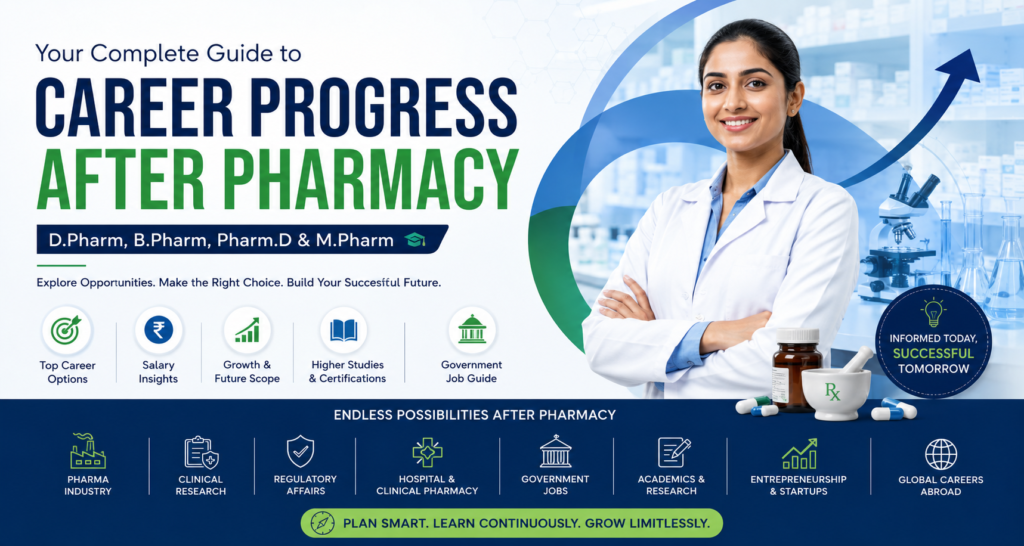
Every year, more than 2 lakh students enroll in pharmacy courses across India. Unfortunately, a large percentage of them choose pharmacy without understanding its actual career opportunities, salary structure, competition, future scope, and challenges.
Some students join because someone advised them.
Some because they couldn’t get MBBS.
Some because pharmacy colleges offered easy admission.
Others simply had no idea what to choose after Class 12.
After completing the course, many realize that they don’t know what to do next.
This comprehensive guide aims to answer every important question honestly so that students can make informed career decisions.
What is Pharmacy?
Pharmacy is the science of medicines.
A pharmacist is involved in:
- Drug discovery
- Drug formulation
- Manufacturing
- Quality Control
- Quality Assurance
- Clinical Research
- Regulatory Affairs
- Pharmacovigilance
- Hospital Pharmacy
- Community Pharmacy
- Medical Writing
- Drug Safety
- Research
- Academics
- Government Drug Regulation
Contrary to common belief, pharmacy is much more than selling medicines.
Different Pharmacy Courses in India
1. D.Pharm (Diploma in Pharmacy)
Duration: 2 Years
Suitable for students who:
- Want to become Registered Pharmacists quickly
- Plan to open a medical store
- Wish to work in hospitals or retail pharmacy
- Need a shorter and more affordable course
Advantages
- Short duration
- Lower fees
- Eligible for pharmacist registration
- Can pursue B.Pharm later
Limitations
Career growth is comparatively limited unless higher education or additional skills are acquired.
2. B.Pharm (Bachelor of Pharmacy)
Duration: 4 Years
This is the most popular pharmacy degree in India.
It opens opportunities in:
- Pharmaceutical Industries
- Government Jobs
- Drug Inspector
- Pharmacist Recruitment
- Production
- QA
- QC
- Regulatory Affairs
- Medical Coding
- Clinical Research
- Pharmacovigilance
- Higher Education
3. Pharm.D
Duration:
- 6 Years (Regular)
- 3 Years (Post Baccalaureate)
Pharm.D focuses mainly on patient care and clinical pharmacy.
Career opportunities include:
- Clinical Pharmacist
- Hospital Pharmacist
- Clinical Research
- Pharmacovigilance
- Medical Writing
- Drug Safety
- International Opportunities
4. M.Pharm
Duration: 2 Years
Specializations include:
- Pharmaceutics
- Pharmaceutical Chemistry
- Pharmacology
- Pharmacognosy
- Quality Assurance
- Pharmaceutical Analysis
- Industrial Pharmacy
- Regulatory Affairs
M.Pharm is recommended for students interested in:
- Research
- Teaching
- Specialized Industry Roles
- PhD
Should You Choose Pharmacy?
Before taking admission, ask yourself:
- Do you enjoy Biology and Chemistry?
- Are you interested in medicines?
- Can you continue learning throughout your career?
- Are you willing to develop additional skills beyond your degree?
- Are you comfortable working in healthcare or the pharmaceutical industry?
If your answer is “Yes,” pharmacy can be a rewarding career.
If your only expectation is a high-paying job immediately after graduation without building skills, you may be disappointed.
Reality of Pharmacy Education in India
This is the topic very few colleges discuss honestly.
Major Challenges
- Too many pharmacy colleges
- Variable quality of education
- Limited practical exposure in some institutes
- Industry-ready skills often lacking
- Campus placements differ significantly among colleges
Many students graduate with a degree but without practical confidence.
Therefore, your personal effort matters more than your college name in many situations.
Is Pharmacy an Easy Degree?
Absolutely not.
Students study:
- Human Anatomy
- Physiology
- Biochemistry
- Pharmaceutical Chemistry
- Organic Chemistry
- Medicinal Chemistry
- Pharmacology
- Pharmaceutics
- Microbiology
- Biotechnology
- Pharmaceutical Analysis
- Biopharmaceutics
- Pharmacokinetics
- Quality Assurance
- Hospital Pharmacy
- Clinical Pharmacy
- Regulatory Affairs
The syllabus is extensive and requires regular study.
Does Every Pharmacy Student Get a Job?
No.
A pharmacy degree does not automatically guarantee employment.
Employment depends on:
- Skills
- Communication
- Computer knowledge
- Internship experience
- Practical exposure
- Interview preparation
- English communication
- Networking
- Continuous learning
Students who continuously improve themselves generally have more opportunities.
Career Options After D.Pharm
Possible paths include:
- Hospital Pharmacist
- Retail Pharmacist
- Medical Store Owner
- Government Pharmacist
- Community Pharmacy
- Drug Distribution
- Pharmaceutical Sales
- B.Pharm through lateral entry
Career Options After B.Pharm
Students can work in:
Pharmaceutical Manufacturing
Departments include:
- Production
- Packaging
- Warehouse
- Quality Assurance
- Quality Control
Research & Development
Suitable for students interested in innovation and formulation development.
Regulatory Affairs
Responsibilities include:
- Drug registration
- Documentation
- Global regulatory compliance
Pharmacovigilance
Monitoring medicine safety after marketing.
Demand continues to grow with expanding pharmaceutical regulations.
Clinical Research
Opportunities include:
- Clinical Trial Coordination
- Clinical Data Management
- Site Management
Medical Writing
Preparation of:
- Clinical documents
- Scientific articles
- Regulatory documents
- Drug monographs
- Educational content
Medical Coding
Healthcare documentation and coding for insurance and hospital systems.
Sales & Marketing
Pharmaceutical marketing remains one of the largest employment sectors for pharmacy graduates.
Performance-based incentives may significantly increase earnings.
Digital Healthcare
Growing opportunities include:
- Health-tech companies
- Telemedicine platforms
- AI-assisted healthcare
- Digital therapeutics
- Healthcare analytics
Career Options After Pharm.D
- Clinical Pharmacist
- Drug Information Specialist
- Pharmacovigilance Officer
- Medical Writer
- Hospital Administrator
- Clinical Research Associate
- Patient Safety Associate
- Clinical Data Reviewer
Career Options After M.Pharm
Students may pursue:
- Scientist positions
- Research Associate
- Assistant Professor
- QA/QC Specialist
- Regulatory Affairs Specialist
- Formulation Scientist
- PhD
- Government Research Organizations
Government Job Opportunities
Students frequently ask:
“Can pharmacy graduates get government jobs?”
Yes.
Some major options include:
- Pharmacist (Central Government)
- State Government Pharmacist
- ESIC
- Railways
- CGHS
- AIIMS
- Armed Forces Medical Services
- ECHS
- State Health Departments
- Drug Inspector
- Drug Control Administration
- Food Safety Officer (where eligible)
- Scientific Assistant (depending on recruitment rules)
- Public Sector Undertakings (eligibility varies)
Competition is often intense, and eligibility differs across notifications.
Can Pharmacy Graduates Become Drug Inspectors?
Yes, subject to the eligibility criteria prescribed in the recruitment notification and applicable rules.
This remains one of the most sought-after career options.
Preparation generally requires strong knowledge of:
- Pharmaceutical Chemistry
- Pharmacology
- Pharmaceutics
- Pharmaceutical Jurisprudence
- Drug laws
Can Pharmacy Graduates Go Abroad?
Yes.
Popular destinations include:
- USA
- Canada
- Australia
- Ireland
- New Zealand
- Gulf Countries
- United Kingdom
Requirements vary by country and may include licensing examinations, language proficiency tests, or credential evaluation.
Higher Education Options
Students may choose:
- M.Pharm
- MBA
- MPH
- MSc (selected areas where eligible)
- Clinical Research Programs
- Regulatory Affairs Certifications
- Data Analytics
- Artificial Intelligence in Healthcare
- PhD
Is MBA Better Than M.Pharm?
It depends on your career goals.
Choose M.Pharm if you enjoy:
- Research
- Academics
- Technical pharmaceutical roles
Choose MBA if you are interested in:
- Business
- Marketing
- Management
- Pharmaceutical leadership
- Entrepreneurship
Neither option is universally better; the right choice depends on your interests and long-term plans.
Entrepreneurship Opportunities
Pharmacy graduates can build businesses such as:
- Retail Pharmacy
- Wholesale Drug Distribution
- Pharmaceutical Consultancy
- Online Education
- Medical Content Creation
- Healthcare Startups
- Pharmaceutical Training Institutes
- Medical Device Distribution
Skills That Matter More Than Your Degree
The industry increasingly values practical skills.
Develop:
- English Communication
- Presentation Skills
- MS Excel
- PowerPoint
- Data Analysis
- Scientific Writing
- Artificial Intelligence tools
- Digital Marketing
- Research Methodology
- Interview Skills
- Leadership
- Networking
Common Mistakes Pharmacy Students Make
- Choosing the course without research
- Ignoring internships
- Focusing only on passing exams
- Neglecting communication skills
- Depending solely on campus placement
- Preparing for government exams too late
- Not building a professional LinkedIn profile
- Avoiding industry certifications
- Ignoring software and digital skills
Frequently Asked Questions
Is pharmacy saturated?
Some traditional roles face high competition because the number of graduates has increased. However, newer areas such as pharmacovigilance, regulatory affairs, clinical research, digital health, medical writing, and pharmaceutical technology continue to create opportunities for candidates with relevant skills.
Is B.Pharm better than BSc?
It depends on your career goals.
Choose B.Pharm if your interest is healthcare and medicines.
Choose BSc if your interests align more with basic sciences or other specialized academic paths.
Can I prepare for UPSC after Pharmacy?
Yes.
Many pharmacy graduates successfully prepare for:
- UPSC
- State PSC
- SSC
- Banking
- Railways
- Teaching
- Defence
Can girls build a successful pharmacy career?
Absolutely.
Women are contributing successfully across hospitals, industry, research, academia, clinical practice, entrepreneurship, and regulatory organizations.
Is M.Pharm compulsory?
No.
Many successful professionals work after B.Pharm.
Higher education should be based on career goals rather than social pressure.
Can I switch careers after Pharmacy?
Yes.
Many graduates move into:
- Management
- Civil Services
- Data Analytics
- Healthcare IT
- Digital Marketing
- Education
- Entrepreneurship
- Corporate roles
How to Decide Whether Pharmacy Is Right for You
Choose pharmacy if:
✔ You enjoy science, especially biology and chemistry.
✔ You are interested in healthcare and medicines.
✔ You are willing to continue learning throughout your career.
✔ You want diverse career options in industry, hospitals, research, government, or entrepreneurship.
Reconsider if:
✘ You expect a guaranteed high salary immediately after graduation.
✘ You are choosing the course only because someone else suggested it.
✘ You have no interest in science or healthcare.
Final Thoughts
Pharmacy is neither a “shortcut to success” nor a “failed career.” It is a professional healthcare field with broad opportunities—but success depends on informed decisions, continuous learning, practical experience, and adaptability.
Today’s pharmacy graduates are no longer limited to manufacturing or dispensing medicines. They are contributing to drug development, patient safety, clinical research, regulatory science, digital health, artificial intelligence, medical communication, entrepreneurship, and public healthcare.
If you are planning your future, don’t choose pharmacy based only on college advertisements, social media claims, or hearsay. Research the course, understand your interests, speak with professionals, compare career paths, and invest in skill development alongside your degree.
A pharmacy qualification can become the foundation for a meaningful and successful career—but like any profession, the outcome depends largely on your preparation, commitment, and the choices you make after graduation.
Disclaimer
Career opportunities, eligibility conditions, recruitment rules, salaries, and admission requirements may change over time depending on government regulations, institutional policies, and industry trends. Students should always verify the latest official notifications before making academic or career decisions.