
The pharmacy profession has always been regarded as one of the pillars of the healthcare system. Pharmacists ensure the safe and effective use of medicines, contribute to patient care, support public health initiatives, participate in research, and play a significant role in pharmaceutical manufacturing and regulation.
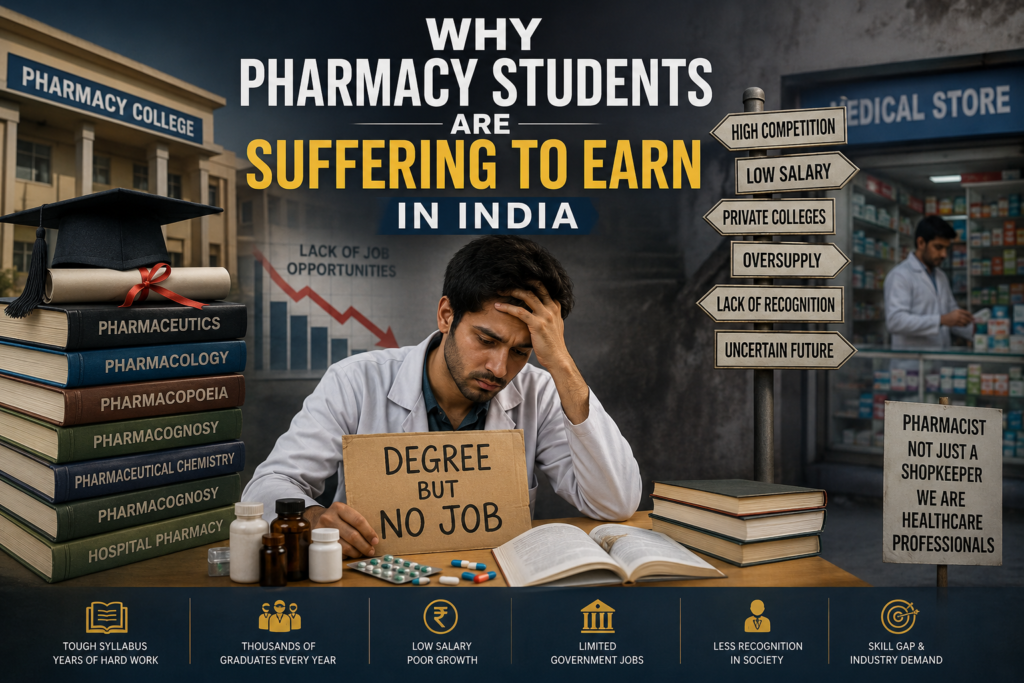
However, despite investing four to six years in higher education and acquiring specialized scientific knowledge, thousands of pharmacy graduates in India are struggling to secure respectable employment and sustainable incomes. Many students enter pharmacy with dreams of becoming healthcare professionals, only to find themselves facing unemployment, low salaries, limited career growth, and declining social recognition.
This blog explores the current condition of pharmacy education and employment in India, identifies the major reasons behind the crisis, and discusses practical solutions that can help restore the dignity of the profession.
Introduction
India is known as the “Pharmacy of the World” because it is one of the largest producers of generic medicines globally. The Indian pharmaceutical industry supplies affordable medicines to more than 200 countries and contributes significantly to the global healthcare system.
Ironically, while the pharmaceutical industry continues to grow, the condition of many pharmacy graduates tells a different story.
Every year, tens of thousands of students complete D.Pharm, B.Pharm, M.Pharm, and Pharm.D programs. Yet only a small percentage obtain well-paying jobs in hospitals, government organizations, regulatory agencies, research institutions, or reputed pharmaceutical companies.
The question therefore arises:
Why are pharmacy students struggling to earn despite belonging to one of the most important healthcare professions?
The answer lies not in one factor, but in a combination of educational, industrial, regulatory, and social issues.
Pharmacy Education in India: An Overview
India offers several pharmacy programs:
- Diploma in Pharmacy (D.Pharm)
- Bachelor of Pharmacy (B.Pharm)
- Master of Pharmacy (M.Pharm)
- Doctor of Pharmacy (Pharm.D)
- Ph.D. in Pharmaceutical Sciences
These programs are regulated primarily by the Pharmacy Council of India (PCI) and the All India Council for Technical Education (AICTE) depending on the course and institution.
On paper, the curriculum is extensive and scientifically demanding.
Students study:
- Human Anatomy
- Physiology
- Pharmaceutical Chemistry
- Pharmacology
- Pharmaceutics
- Pharmacognosy
- Pharmaceutical Analysis
- Biochemistry
- Microbiology
- Clinical Pharmacy
- Hospital Pharmacy
- Biostatistics
- Drug Regulatory Affairs
- Medicinal Chemistry
A pharmacy graduate spends years understanding medicines from molecular structure to patient counseling.
Yet this academic effort often does not translate into financial stability.
Is Pharmacy Really an Easy Degree?
One of the biggest misconceptions in society is that pharmacy is an “easy degree.”
The reality is completely different.
A pharmacy student studies subjects that overlap with:
- Chemistry
- Biology
- Medicine
- Mathematics
- Toxicology
- Biotechnology
- Human physiology
Students must understand:
- Drug mechanisms
- Drug interactions
- Pharmacokinetics
- Pharmacodynamics
- Pharmaceutical calculations
- Quality assurance
- Analytical instrumentation
- Clinical therapeutics
Unlike many general degree programs, pharmacy combines theoretical learning with practical laboratory training.
Students spend hundreds of hours performing experiments involving chromatography, spectroscopy, dissolution studies, formulation development, sterility testing, and analytical chemistry.
It is a highly technical healthcare degree.
Government Pharmacy Exams Are Among the Toughest
Many students believe that after completing B.Pharm, obtaining a government job is straightforward.
The reality is exactly the opposite.
Government pharmacist recruitment examinations are highly competitive.
Some popular examinations include:
- State Pharmacist Recruitment
- ESIC Pharmacist
- AIIMS Pharmacist
- Railway Pharmacist
- SSC Pharmacist
- Military Pharmacist
- Drug Inspector
- Pharmacovigilance posts
- CDSCO vacancies
- State Drug Control Administration
In several recruitments:
- Lakhs of candidates compete.
- Vacancy numbers remain extremely low.
- Cut-offs are exceptionally high.
A candidate often studies:
- Pharmacy
- General Knowledge
- Reasoning
- English
- Current Affairs
- Computer Awareness
Many candidates spend years preparing before obtaining a single government appointment.
The Oversupply of Pharmacy Graduates
Perhaps the biggest challenge today is the excessive number of pharmacy colleges.
During the past two decades:
- Hundreds of private pharmacy colleges were established.
- Admission capacity increased rapidly.
- Student intake often exceeded market demand.
As a result:
Every year India produces far more pharmacy graduates than the healthcare system can absorb.
Basic economics applies:
Higher supply + Limited demand = Lower salaries.
This imbalance has significantly affected employment opportunities.
Are Private Colleges Responsible?
This is a sensitive but important issue.
Not every private institution is the same. Many colleges provide excellent education, strong laboratories, experienced faculty, and industry exposure.
However, concerns have often been raised about some institutions where commercial pressures outweigh academic standards.
Common criticisms include:
- Minimal practical exposure
- Weak laboratory infrastructure
- Limited hospital training
- Poor industry interaction
- Inadequate faculty development
- Focus on maintaining admissions rather than improving quality
Another concern frequently discussed among students is that some institutions rarely fail students because consistently high pass percentages may help maintain admissions and institutional reputation.
It is important to avoid generalizing this practice to all colleges, as there is no evidence that every private college follows such an approach. However, if academic standards are compromised anywhere, graduates may enter the workforce without sufficient practical competence, which ultimately affects patient safety, employer confidence, and the reputation of the profession.
Academic evaluation should reflect actual learning outcomes rather than commercial interests.
Skill Gap Between Education and Industry
Many employers expect graduates to possess:
- GMP knowledge
- Documentation skills
- Quality management
- Regulatory affairs
- Validation
- HPLC operation
- GC operation
- Clinical research
- Pharmacovigilance
- Data analysis
- Communication skills
Unfortunately, many colleges remain focused primarily on university examinations.
Consequently:
Students graduate with degrees but limited practical industry readiness.
This gap forces companies to spend additional resources on training, making fresh graduates less competitive.
Why Are Salaries So Low?
One of the biggest disappointments among pharmacy graduates is salary.
Many fresh graduates receive salaries that are only modestly above local minimum wage levels, especially in retail or small manufacturing settings.
Common reasons include:
- Oversupply of graduates
- Intense competition
- Small-scale pharmaceutical employers
- Lack of specialization
- Regional salary differences
- Limited bargaining power
In contrast, graduates from premier institutions or those with specialized skills in regulatory affairs, clinical research, pharmacovigilance, formulation R&D, or quality assurance may secure significantly better opportunities.
Current Social Status of Pharmacists in India
Despite being healthcare professionals, pharmacists often receive less public recognition than doctors and nurses.
Many people mistakenly assume pharmacists only:
- Dispense medicines
- Sell medicines
- Manage medical stores
In reality, pharmacists contribute to:
- Medication safety
- Patient counseling
- Drug interaction prevention
- Rational medicine use
- Public health programs
- Pharmacovigilance
- Clinical pharmacy services
- Drug manufacturing
- Quality assurance
- Research and development
The profession’s scientific contributions are substantial, yet public awareness remains limited.
Lack of Clinical Utilization
In many developed healthcare systems, pharmacists actively participate in:
- Clinical rounds
- Medication therapy management
- Chronic disease counseling
- Vaccination programs
- Antimicrobial stewardship
- Patient education
In India, clinical pharmacy services are expanding but remain uneven across hospitals. As a result, many pharmacists continue to work primarily in dispensing or manufacturing roles rather than in broader patient-care responsibilities.
Limited Government Recruitment
Government pharmacist vacancies are released periodically, but compared with the number of qualified graduates, opportunities remain limited.
Many candidates prepare for years because:
- Recruitment cycles may be infrequent.
- Court cases or administrative delays can postpone appointments.
- Competition is intense.
This creates uncertainty and financial stress for graduates.
The Rise of Contractual Employment
Another concern is the increasing use of contractual or outsourced recruitment in some sectors.
Contract-based employment may offer:
- Lower salaries
- Limited job security
- Fewer promotion opportunities
- Reduced long-term benefits compared with regular government positions
This affects career stability for many pharmacy professionals.
Mental Health Challenges
Continuous examination preparation…
Repeated failures…
Financial pressure…
Family expectations…
Peer comparison…
Unemployment…
All these factors contribute to anxiety, stress, and burnout among many pharmacy graduates.
Mental well-being deserves as much attention as academic performance.
Is the Pharmaceutical Industry Growing?
Yes.
India’s pharmaceutical industry continues to expand in:
- Generic medicines
- Vaccines
- Biosimilars
- APIs
- Clinical research
- Exports
- Biotechnology
However, industry growth does not automatically guarantee high-quality employment for every graduate. The distribution of opportunities depends on skills, specialization, location, and market demand.
What Can Students Do?
Students should focus beyond university examinations.
They should develop skills in:
- English communication
- Computer applications
- Data analysis
- GMP documentation
- Regulatory affairs
- Pharmacovigilance
- Clinical research
- Medical writing
- AI tools
- Presentation skills
Internships and certifications can also improve employability.
What Should Colleges Improve?
Educational institutions should strengthen:
- Practical laboratory training
- Industry internships
- Hospital exposure
- Soft skills
- Placement support
- Research culture
- Faculty development
- Entrepreneurship training
Quality education should be the priority over enrollment numbers.
Policy-Level Improvements
Several measures could strengthen the profession:
- Regular review of educational capacity against workforce needs.
- Stronger quality assurance for pharmacy institutions.
- Expanded clinical roles for pharmacists where appropriate.
- Better collaboration between academia and industry.
- More structured internship opportunities.
- Increased public awareness of pharmacists’ contributions.
- Transparent and timely recruitment processes in the public sector.
Conclusion
The struggle of pharmacy students in India is not the result of a single failure but the combined effect of educational expansion, uneven training quality, intense competition, skill gaps, limited high-quality jobs, and inadequate public recognition of pharmacists’ expertise.
At the same time, it is important to recognize that pharmacy remains a profession with meaningful opportunities. Graduates who continuously build practical skills, adapt to new technologies, and explore emerging fields such as regulatory affairs, pharmacovigilance, clinical research, medical writing, biotechnology, and digital health are often better positioned in the evolving job market.
Addressing the current challenges will require coordinated efforts from students, educational institutions, employers, regulators, and policymakers. Strengthening education quality, aligning training with industry needs, and expanding the professional role of pharmacists can help ensure that future graduates receive the respect, opportunities, and career growth that their scientific education deserves.
References
- Pharmacy Council of India – Education Regulations, pharmacy curriculum, and institutional standards.
- All India Council for Technical Education – Technical education policies and approvals.
- National Board of Accreditation – Accreditation and quality standards.
- Indian Pharmaceutical Alliance – Industry reports and sector insights.
- Department of Pharmaceuticals – Policy documents and pharmaceutical sector initiatives.
- Ministry of Health and Family Welfare – Public health and healthcare workforce policies.
- National Health Authority – Healthcare system initiatives relevant to pharmacists.
- Government recruitment notifications from organizations such as ESIC, AIIMS, Railways, state governments, and other public sector employers (reviewed over time for vacancy patterns and eligibility requirements).