
India is widely celebrated as the “Pharmacy of the World,” supplying over 20% of global generic medicines and meeting more than 60% of the world’s vaccine demand. However, behind this multi-billion dollar manufacturing powerhouse lies a stark paradox facing pharmacy graduates.
Every year, hundreds of thousands of students complete their Bachelor of Pharmacy (B.Pharm) degrees with hopes of landing lucrative careers in drug discovery, manufacturing, or healthcare. Yet, a substantial portion faces underemployment, wage stagnation, or difficulty finding core roles aligned with their qualifications.
Key Statistics & Data at a Glance
Recent reports from the India Skills Report, the Federation of Indian Pharmacists Organisations (FIPO), and industry research reveal both the challenges and gradual improvements in pharmacy graduate employability:
| Metric / Indicator | Statistical Figure | Primary Source / Context |
| Annual Pharmacy Graduates Outflow | ~5,000,000 across D.Pharm, B.Pharm, & M.Pharm | PCI & Ministry of Health Data |
| B.Pharm Employability Rate | ~58% | India Skills Report |
| Industry Unemployability / Skill-Gap | 42% – 70% (for core high-tech roles) | Industry-Academia Gap Studies |
| Average Starting Salary (Entry Level) | ₹12,000 – ₹22,000 / month | Core Manufacturing & Sales Roles |
| High-Growth Non-Traditional Sectors | Pharmacovigilance, Regulatory Affairs, CDM | IT & KPO Sectors |
Primary Root Causes Behind B.Pharm Unemployment & Underemployment
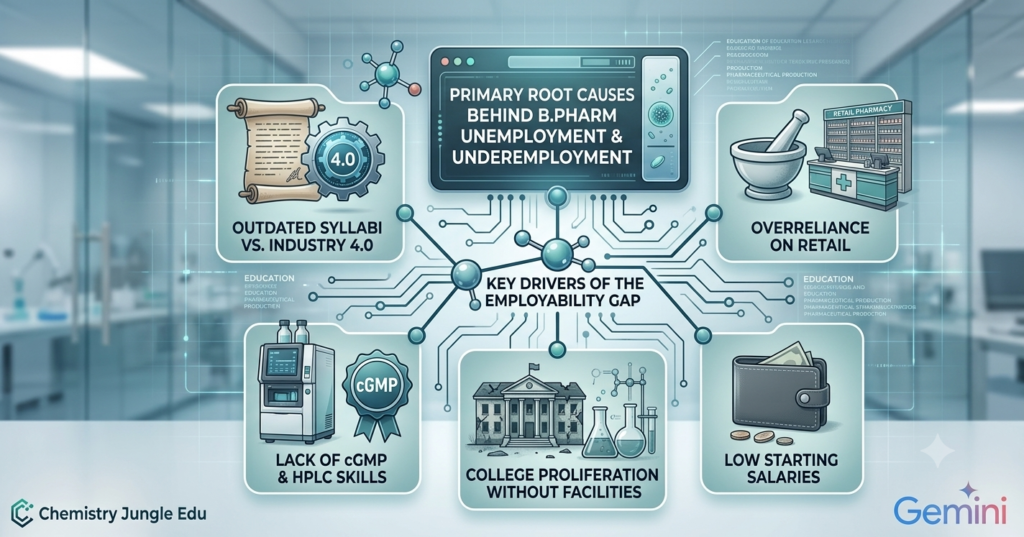
- Syllabus Disconnect from Modern Industry: Traditional B.Pharm curricula often focus heavily on theoretical formulation chemistry rather than modern industry tools like HPLC/LC-MS instrumentation, cGMP compliance, Clinical Data Management (CDM), and Regulatory Filings (USFDA/EMA).
- Proliferation of Tier-3 Colleges: Rapid expansion of private pharmacy institutes without adequate wet labs or industry partnerships has created a discrepancy in training quality.
- Stagnant Starting Compensation: Entry-level plant roles in Quality Control (QC) or Production often start at ₹10,000–₹18,000/month, leading many graduates to leave the domain for non-pharma jobs.
Sector-Wise Employment Analysis for B.Pharm Graduates
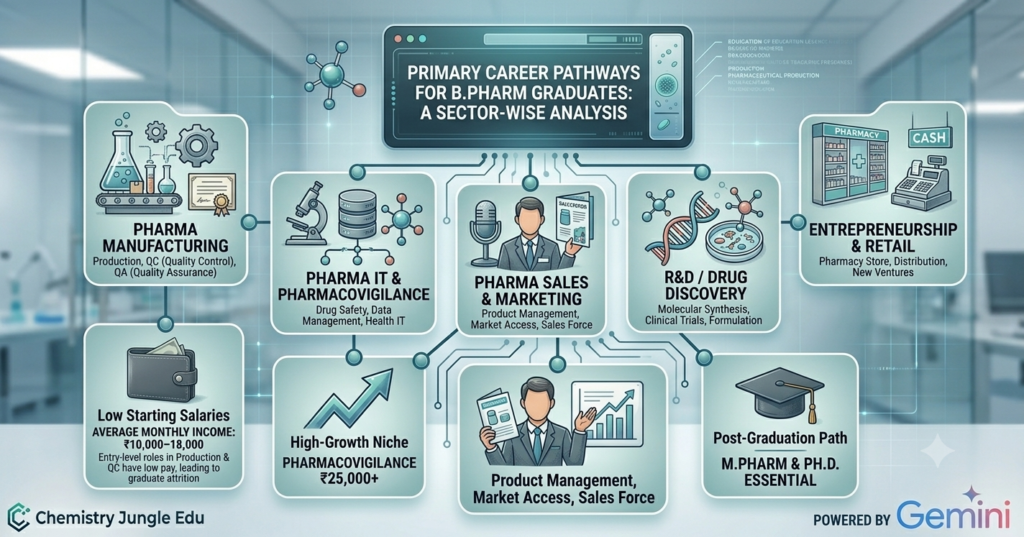
1. Pharmaceutical Manufacturing (Production, Quality Control & Assurance)
- Current Situation: India’s manufacturing hubs (Gujarat, Himachal Pradesh, Telangana, Maharashtra) absorb thousands of graduates. However, production and QC roles are labor-intensive with strict shift work and modest starting pay.
- Employability Factor: High demand for basic technical workforce, but employers report spending 3–6 months retraining freshers on actual Good Manufacturing Practices (cGMP) and automated machinery.
2. IT, HealthTech, Pharmacovigilance (PV) & Clinical Research
- Current Situation: This is currently the most sought-after sector for B.Pharm graduates. Global CROs (Contract Research Organizations) and IT multinationals (e.g., Cognizant, TCS, Accenture, IQVIA) recruit B.Pharm graduates for roles in:
- Pharmacovigilance (Drug Safety Associate)
- Clinical Data Management (CDM)
- Medical Coding & Medical Writing
- Regulatory Affairs (RA)
- Employability Factor: High salary potential (₹3.5 LPA – ₹6.0 LPA starting), but requires soft skills, software proficiency, and medical terminologies.
3. Sales & Marketing (Medical Representative to Brand Management)
- Current Situation: Sales remains one of the largest immediate employers for B.Pharm freshers.
- Employability Factor: Offers clear performance-based growth and incentives, but high targets and field stress lead to high turnover rates among young graduates.
4. Research & Drug Development (R&D)
- Current Situation: Pure R&D roles (Formulation Development, Synthetic Chemistry, Analytical R&D) generally require an M.Pharm, Pharm.D, or Ph.D.
- Employability Factor: Direct entry for B.Pharm degree holders into core drug discovery is low (~5–10%), as companies prefer specialized postgraduate qualifications.
5. Entrepreneurship, Retail & Wholesale Pharmacy
- Current Situation: B.Pharm degree holders possess the legal qualification to open retail chemists, wholesale distribution hubs, or start e-pharmacy platforms.
- Employability Factor: Very high potential. With modern chains (Apollo, MedPlus) and quick-commerce drug delivery platforms growing, skilled community pharmacists and pharmacy store owners are seeing rising demand.
Comparative Sector Matrix for B.Pharm Graduates
| Career Domain | Job Opportunity Level | Avg. Entry Salary (Per Annum) | Required Additional Skills | Growth Prospect |
| Quality Control / Assurance (QC/QA) | High | ₹1.8 L – ₹2.8 L | HPLC, GC, cGMP compliance, GLP | Moderate to High |
| Production & Manufacturing | Very High | ₹1.5 L – ₹2.5 L | Machine operation, SOPs, Batch Processing | Moderate |
| Pharmacovigilance & CDM (IT/KPO) | High | ₹3.5 L – ₹5.5 L | MedDRA coding, ICSR handling, Clinical trial basics | Very High |
| Medical Sales (MR) | Very High | ₹2.4 L – ₹4.0 L + Incentives | Product knowledge, Communication, Negotiation | High |
| Regulatory Affairs (RA) | Moderate | ₹2.8 L – ₹4.5 L | Dossier preparation (eCTD), USFDA/EMA guidelines | High |
| Government (Drug Inspector / Hospital) | Low (Competitive Exams) | ₹5.5 L – ₹9.0 L | GPAT/State PSC prep, Pharmacology expertise | Stable & Prestigious |
| Retail / Wholesale Business | Self-Driven | ₹3.0 L – ₹10.0 L+ | Inventory control, Business management, Compliance | High |
Key Reforms and Government Initiatives
To address the employability gap, the Pharmacy Council of India (PCI) and the Ministry of Health have introduced several structural measures:
- Implementation of Aadhaar & QR Inspections: Eliminating ghost faculty and unequipped institutions to standardize education quality.
- National Exit Test Concept: Standardizing minimum competency standards for registered pharmacists.
- Establishment of Pharmacovigilance & Skill Centers: Strengthening practical skill development across colleges in partnership with IPC (Indian Pharmacopoeia Commission).
Strategic Action Plan for B.Pharm Students
To stand out in the job market, B.Pharm undergraduates should consider the following steps:
- Upskill in High-Demand Niche Fields: Take certified short courses in Pharmacovigilance, Regulatory Affairs (eCTD), Clinical Data Management (CDM), or Medical Coding.
- Gain Practical Analytical Instrument Training: Get hands-on exposure to HPLC, UV-Vis Spectroscopy, and Dissolution Apparatus beyond standard lab experiments.
- Target Post-Graduation (GPAT / M.Pharm): For students aspiring to work in core R&D or academia, cracking GPAT for M.Pharm in NIPER or top tier-1 colleges significantly boosts career prospects.
- Develop Soft Skills and Professional English: Essential for IT-enabled services, clinical trials coordination, and corporate marketing roles.
Frequently Asked Questions (FAQs)
1. What is the current employability rate of B.Pharm graduates in India?
According to the India Skills Report, employability in the pharmacy sector stands at approximately 58%. While foundational hiring remains steady, specialized technical roles face a talent gap due to outdated college curricula.
2. Can a B.Pharm graduate get a job in the IT sector?
Yes. IT giants and healthcare KPOs actively hire B.Pharm graduates for specialized roles in Pharmacovigilance (PV), Clinical Data Management (CDM), Medical Writing, and Healthcare Analytics.
3. Is B.Pharm better than D.Pharm for finding employment?
Yes. D.Pharm (Diploma) is primarily tailored for community retail pharmacy counters, whereas B.Pharm (Bachelor’s Degree) opens up opportunities in drug manufacturing, QA/QC, clinical research, marketing, government drug inspection, and higher studies (M.Pharm/MBA).
4. What is the starting salary for a B.Pharm fresher in India?
Starting salaries vary significantly by domain:
- Plant Production / QC: ₹12,000 – ₹20,000 per month
- Medical Representative (Sales): ₹18,000 – ₹28,000 per month + incentives
- Pharmacovigilance / IT KPO: ₹25,000 – ₹40,000 per month
5. What are the best government job options after B.Pharm?
B.Pharm graduates can apply for positions such as Drug Inspector (DI) through UPSC/State PSCs, Government Hospital Pharmacist (Railway, ESIC, Defense), and research posts in government laboratories (CDRI, CSIR, ICMR).
Sources
- India Skills Report – Sectoral Employability Trends & Statistics.
- Pharmacy Council of India (PCI) – Education Regulations & Institutional Oversight Updates.
- Ministry of Health and Family Welfare (Press Information Bureau) – Quality Control and Regulatory Reforms in Pharmacy Education.
- Federation of Indian Pharmacists Organisations (FIPO) – Industry Employment & Registered Pharmacist Statistics.