
Read Part 1: Introduction, Industry Overview, Trends 1–5 (AI, Biosimilars, API Self-Reliance, CDMO Growth, and GLP-1 Medicines).Top 10 Emerging Trends in the Indian Pharmaceutical Industry (2026): Opportunities, Challenges, and Future Outlook
Trend 6: Digital Manufacturing and Industry 4.0
The pharmaceutical industry is undergoing a digital transformation with the adoption of Industry 4.0 technologies, including automation, robotics, Industrial Internet of Things (IIoT), cloud computing, digital twins, and advanced analytics. These technologies improve productivity, reduce human error, and strengthen compliance with Good Manufacturing Practices (GMP).
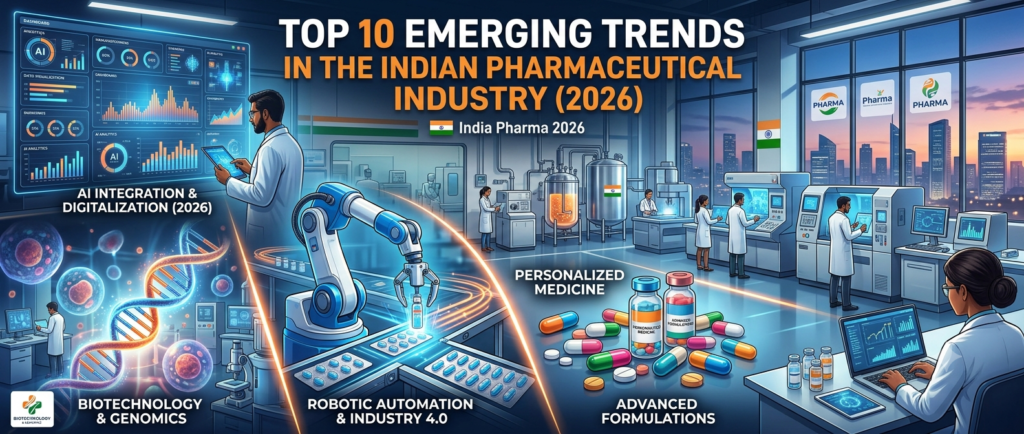
Indian pharmaceutical manufacturers are increasingly investing in smart factories capable of real-time monitoring, predictive maintenance, electronic batch records (EBRs), and automated quality control systems. These innovations not only improve operational efficiency but also reduce production costs and enhance product consistency.
Benefits of Industry 4.0 in Pharma
| Technology | Application | Benefits |
|---|---|---|
| Artificial Intelligence | Process optimization | Improved efficiency |
| Industrial IoT | Equipment monitoring | Reduced downtime |
| Robotics | Packaging and material handling | Increased productivity |
| Cloud Computing | Data storage and analytics | Better collaboration |
| Digital Twins | Process simulation | Faster optimization |
| Automation | Manufacturing operations | Reduced manual intervention |
Industry Impact
Companies embracing digital manufacturing are likely to achieve faster production cycles, improved quality assurance, enhanced regulatory compliance, and stronger global competitiveness.
Trend 7: Precision Medicine and Pharmacogenomics
Healthcare is gradually shifting from a “one-size-fits-all” approach to personalized medicine, where treatment decisions are based on an individual’s genetic profile, lifestyle, and disease characteristics.
Pharmacogenomics studies how genetic variations influence a patient’s response to medications. This enables healthcare professionals to prescribe the most effective medicine with fewer adverse effects.
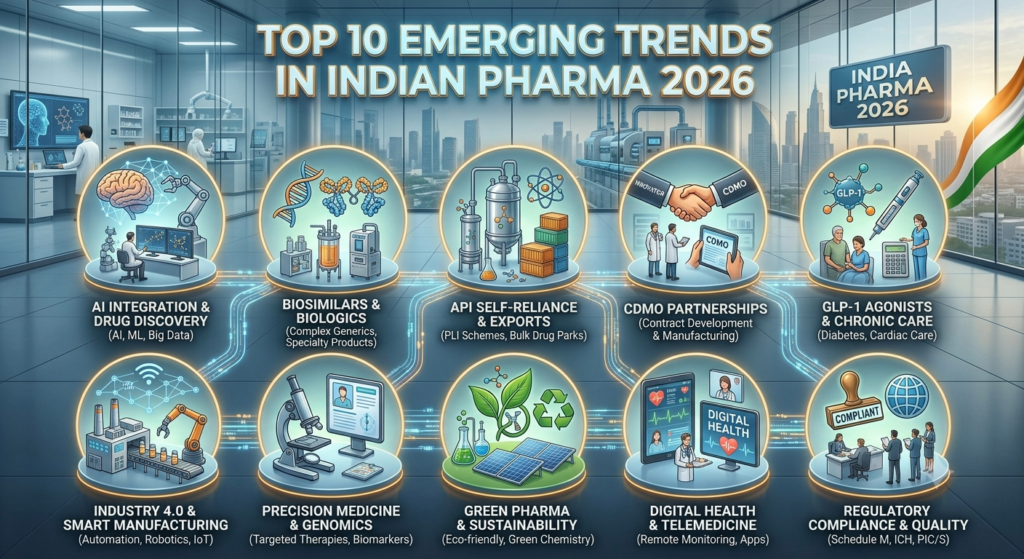
India’s expanding biotechnology ecosystem, improving genomic research infrastructure, and declining sequencing costs are accelerating the adoption of precision medicine.
Applications
- Oncology
- Rare genetic disorders
- Cardiovascular diseases
- Neurological disorders
- Diabetes management
Benefits
- Improved treatment outcomes
- Reduced adverse drug reactions
- Better patient compliance
- Efficient healthcare resource utilization
Trend 8: Green Pharmaceuticals and Sustainable Manufacturing
Environmental sustainability has become an important strategic priority for pharmaceutical companies worldwide. Regulatory agencies, investors, and consumers increasingly expect companies to minimize their environmental footprint.
Indian pharmaceutical manufacturers are adopting sustainable practices such as:
- Green chemistry
- Water conservation
- Renewable energy
- Zero-liquid discharge systems
- Waste minimization
- Carbon emission reduction
Sustainability Initiatives
| Initiative | Expected Benefit |
|---|---|
| Green Chemistry | Reduced hazardous chemicals |
| Solar Energy | Lower energy costs |
| Water Recycling | Sustainable resource utilization |
| Waste Management | Environmental compliance |
| Energy-efficient Equipment | Lower carbon footprint |
Why It Matters
Companies demonstrating strong Environmental, Social, and Governance (ESG) performance are likely to gain better investor confidence, stronger global partnerships, and improved regulatory acceptance.
Trend 9: Expansion of Digital Health, E-Pharmacy, and Telemedicine
Digital healthcare has experienced remarkable growth in India. Increasing internet penetration, smartphone usage, and government initiatives have accelerated the adoption of telemedicine and digital health services.
Pharmaceutical companies are increasingly collaborating with healthcare technology firms to improve patient engagement and medication adherence.
Emerging Digital Healthcare Services
| Service | Benefits |
|---|---|
| Telemedicine | Improved healthcare accessibility |
| E-Pharmacy | Convenient medicine delivery |
| Mobile Health Apps | Better disease monitoring |
| Electronic Health Records | Improved patient management |
| AI Chatbots | Patient support and counseling |
Future Outlook
Digital health integration will strengthen chronic disease management, improve patient outcomes, and create new business opportunities for pharmaceutical companies.
Trend 10: Strengthening Global Regulatory Compliance
Regulatory compliance continues to be one of the most important success factors in the pharmaceutical industry.
Indian manufacturers exporting medicines must comply with regulations from agencies such as:
- USFDA
- EMA
- MHRA
- CDSCO
- WHO GMP
- PIC/S
Modern pharmaceutical companies are investing heavily in:
- Data Integrity
- Quality Risk Management
- Electronic Documentation
- Computer System Validation
- Continuous Quality Improvement
Key Regulatory Focus Areas
| Area | Importance |
|---|---|
| Data Integrity | Reliable documentation |
| Good Manufacturing Practices | Product quality |
| Pharmacovigilance | Patient safety |
| Electronic Records | Regulatory compliance |
| Risk Management | Manufacturing excellence |
SWOT Analysis of the Indian Pharmaceutical Industry
| Strengths | Weaknesses |
|---|---|
| Global leadership in generic medicines | Dependence on imported APIs for certain products |
| Cost-effective manufacturing | Pricing pressure |
| Large skilled workforce | Regulatory observations |
| Strong export network | High R&D investment requirements |
| Opportunities | Threats |
|---|---|
| Biosimilars | Global competition |
| Artificial Intelligence | Geopolitical uncertainties |
| Precision Medicine | Supply chain disruptions |
| Digital Health | Changing regulatory landscape |
Major Opportunities for Indian Pharma
1. Growing Global Demand for Affordable Medicines
Aging populations and rising healthcare costs worldwide continue to increase demand for high-quality generic medicines.
2. Patent Expirations
Many blockbuster biologic medicines are approaching patent expiry, creating significant opportunities for biosimilar manufacturers.
3. Expansion of CDMO Services
Global pharmaceutical companies increasingly outsource manufacturing to trusted partners.
4. Government Support
Government initiatives continue to encourage domestic manufacturing and innovation.
5. Digital Transformation
AI, automation, and digital manufacturing are improving competitiveness.
Key Challenges
- Regulatory compliance costs
- Intellectual property issues
- Pricing pressure
- Skilled workforce requirements
- Cybersecurity risks
- Climate-related operational challenges
- Global geopolitical uncertainties
Future Outlook (2026–2030)
India is expected to remain one of the world’s fastest-growing pharmaceutical markets. The industry’s future growth will increasingly depend on innovation rather than volume alone.
Key priorities over the coming years are likely to include:
- AI-driven drug discovery
- Biosimilar expansion
- Precision medicine
- Digital manufacturing
- Green pharmaceutical practices
- Advanced biologics
- Stronger global regulatory compliance
- Increased R&D investment
With supportive government policies, a highly skilled scientific workforce, and expanding global demand for affordable healthcare solutions, India is well-positioned to strengthen its role as a leading global pharmaceutical hub.
Key Takeaways
| Trend | Industry Impact |
|---|---|
| AI | Faster innovation |
| Biosimilars | Affordable biologic therapies |
| API Manufacturing | Supply chain resilience |
| CDMO | Export growth |
| GLP-1 Medicines | New therapeutic opportunities |
| Industry 4.0 | Smart manufacturing |
| Precision Medicine | Personalized healthcare |
| Sustainability | Long-term competitiveness |
| Digital Health | Better patient engagement |
| Regulatory Excellence | Global market access |
Frequently Asked Questions (FAQs)
1. Why is India called the “Pharmacy of the World”?
India is one of the world’s largest producers of generic medicines and vaccines, supplying affordable pharmaceutical products to more than 200 countries.
2. Which segment will grow the fastest by 2030?
Biosimilars, biologics, AI-enabled drug discovery, CDMO services, and digital healthcare are expected to experience strong growth.
3. What role does Artificial Intelligence play in pharmaceuticals?
AI supports drug discovery, manufacturing optimization, pharmacovigilance, clinical trial design, and supply chain management.
4. What are biosimilars?
Biosimilars are highly similar versions of approved biologic medicines that demonstrate comparable quality, safety, and effectiveness.
5. Why is API manufacturing strategically important?
Domestic API production reduces dependence on imports, strengthens supply chains, and improves pharmaceutical security.
6. What is Industry 4.0?
Industry 4.0 refers to the integration of automation, digital technologies, robotics, AI, and IoT into manufacturing operations.
7. What are the biggest challenges facing Indian pharmaceutical companies?
Regulatory compliance, pricing pressure, global competition, supply chain resilience, and continuous innovation remain key challenges.
8. What career opportunities are emerging in the pharmaceutical industry?
Growing opportunities include Regulatory Affairs, Pharmacovigilance, Clinical Research, Medical Writing, Data Analytics, AI in Healthcare, Biotechnology, Quality Assurance, Manufacturing, and Pharmaceutical Marketing.
Conclusion
The Indian pharmaceutical industry is entering a transformative era characterized by technological innovation, sustainable manufacturing, and a stronger focus on high-value therapies. Artificial intelligence, biosimilars, digital manufacturing, precision medicine, and green pharmaceutical practices are redefining the sector’s future.
While challenges such as regulatory complexity, pricing pressures, and supply chain risks remain, India’s established manufacturing base, skilled workforce, and supportive policy environment position it to remain a global leader in pharmaceutical production and innovation. Companies that invest in research, digital capabilities, sustainability, and international quality standards will be best placed to capitalize on emerging opportunities through 2030 and beyond.
References
- World Health Organization (WHO). Access to Medicines and Pharmaceutical Systems. https://www.who.int
- Department of Pharmaceuticals, Government of India. Annual Reports. https://pharmaceuticals.gov.in
- India Brand Equity Foundation (IBEF). Indian Pharmaceuticals Industry. https://www.ibef.org
- Central Drugs Standard Control Organization (CDSCO). https://cdsco.gov.in
- U.S. Food and Drug Administration (USFDA). https://www.fda.gov
- European Medicines Agency (EMA). https://www.ema.europa.eu
- IQVIA Institute. The Global Use of Medicines Reports. https://www.iqvia.com
- McKinsey & Company. Healthcare Insights. https://www.mckinsey.com
- NITI Aayog. Healthcare and Life Sciences Reports. https://www.niti.gov.in
- Invest India. Pharmaceutical Sector Overview. https://www.investindia.gov.in
- Organisation for Economic Co-operation and Development (OECD). https://www.oecd.org
- World Bank. Health and Economic Development Data. https://www.worldbank.org