
PCI, WHO & THSTI Rational Use of Medicines (RUM) Certificate Course – Complete Guide for Pharmacists
Learn everything about the Rational Use of Medicines (RUM) Certificate Course launched by PCI, WHO India and THSTI. Discover its objectives, eligibility, importance, career benefits, and future prospects for pharmacists.
Introduction
The role of pharmacists is evolving rapidly across the world. Gone are the days when pharmacists were seen only as professionals who dispensed medicines. Today, they are expected to ensure medication safety, educate patients, prevent medication errors, promote the rational use of medicines, and actively contribute to improving healthcare outcomes.
Recognising this global shift, the Pharmacy Council of India (PCI), in collaboration with the World Health Organization (WHO) India Country Office and the Translational Health Science and Technology Institute (THSTI), has introduced the Rational Use of Medicines (RUM) Certificate Course. This online, self-paced learning programme is designed to strengthen pharmacists’ knowledge and equip them with practical skills that support safe, effective, and evidence-based use of medicines.
The initiative is more than just another online certification. It reflects a broader vision of preparing Indian pharmacists for a healthcare system that increasingly values patient-centred care, medication safety, and continuous professional development.
What is the Rational Use of Medicines (RUM) Certificate Course?
The Rational Use of Medicines (RUM) Certificate Course is a free online educational programme developed jointly by PCI, WHO India and THSTI. It aims to enhance pharmacists’ understanding of responsible medicine use and encourage best practices in dispensing, patient counselling, antimicrobial stewardship, pharmacovigilance, and medication safety.
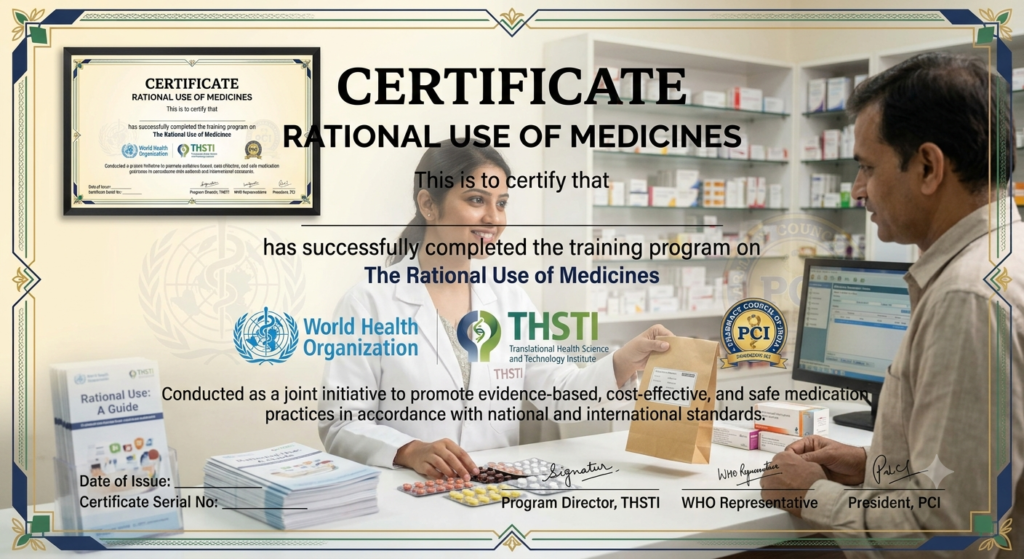
The course is delivered through the THSTI Learning Management System (LMS), allowing participants to study at their own pace from anywhere in the country.
Its primary objective is simple yet significant—to ensure that every pharmacist understands how medicines should be used safely, appropriately, and effectively to achieve the best possible outcomes for patients.
What Does “Rational Use of Medicines” Mean?
The concept of Rational Use of Medicines was introduced by the World Health Organization to promote safe and effective healthcare worldwide.
According to WHO, medicines are used rationally when patients receive medicines appropriate to their clinical needs, in doses that meet their individual requirements, for an adequate duration, and at the lowest possible cost to both the patient and the community.
In practical terms, rational medicine use means:
- Choosing the right medicine for the right patient.
- Using the correct dose and dosage form.
- Administering medicines for the appropriate duration.
- Avoiding unnecessary or duplicate medications.
- Preventing adverse drug reactions and medication errors.
- Educating patients about the proper use of medicines.
When these principles are ignored, the result is irrational medicine use, which contributes to treatment failure, adverse drug reactions, antimicrobial resistance, and increased healthcare costs.
Why Was This Course Introduced?
The launch of the RUM Certificate Course comes at a time when irrational medicine use has become a global public health concern.
The World Health Organization estimates that a significant proportion of medicines worldwide are prescribed, dispensed, or used inappropriately. Common examples include unnecessary antibiotic use, self-medication, polypharmacy, incorrect dosing, and poor patient adherence.
India faces similar challenges due to its large population, increasing burden of chronic diseases, easy access to medicines, and rising antimicrobial resistance.
Pharmacists are often the last healthcare professionals patients meet before taking medicines. Therefore, they play a crucial role in ensuring that medicines are used correctly and safely.
Through this course, PCI, WHO and THSTI aim to strengthen pharmacists’ professional competencies and improve the quality of pharmaceutical care delivered across the country.
Who Should Enrol?
Although the course is primarily designed for registered pharmacists, it is equally beneficial for anyone involved in pharmacy education or medicine use.
The programme is highly recommended for:
- Registered Pharmacists
- D.Pharm, B.Pharm, Pharm.D and M.Pharm students
- Hospital Pharmacists
- Community and Retail Pharmacists
- Jan Aushadhi Pharmacists
- Clinical Pharmacists
- Pharmacy Faculty Members
- Pharmacy Interns
Whether you are a student preparing for your career or an experienced pharmacist looking to update your knowledge, the course offers valuable learning opportunities.
What Will You Learn?
The RUM Certificate Course covers several important areas of modern pharmacy practice.
Participants gain knowledge about:
- Principles of Rational Use of Medicines
- Essential Medicines and National List of Essential Medicines (NLEM)
- Medication Safety
- Antimicrobial Resistance (AMR)
- Responsible Antibiotic Use
- Pharmacovigilance
- Patient Counselling Techniques
- Ethical Pharmacy Practice
- Prescription Assessment
- Communication Skills
- Public Health Responsibilities of Pharmacists
Unlike traditional academic courses that focus mainly on theoretical knowledge, this programme emphasises practical application in everyday pharmacy practice.
Why Is This Course Important?
The importance of this programme extends beyond earning a certificate.
Healthcare systems around the world are increasingly recognising pharmacists as key members of multidisciplinary healthcare teams. Their responsibilities now include medication counselling, monitoring drug therapy, preventing medication errors, and supporting patient safety initiatives.
The RUM Certificate Course helps pharmacists develop these competencies and prepares them for a more active role in patient care.
It also supports national healthcare priorities such as:
- Promoting the safe use of medicines
- Reducing antimicrobial resistance
- Improving medication adherence
- Preventing medication-related harm
- Encouraging evidence-based pharmacy practice
By completing this programme, pharmacists not only improve their professional knowledge but also contribute to improving the overall quality of healthcare delivery.
Why Every Pharmacist Should Consider Completing This Course
Many pharmacists wonder whether an online certificate can truly make a difference in their professional journey.
While the certificate itself may not immediately change one’s job profile or salary, the knowledge gained through the programme can significantly improve professional competence.
Completing the course demonstrates a willingness to engage in continuous professional development—an expectation that is becoming increasingly common in healthcare professions worldwide.
It also enhances confidence in handling patient queries, identifying medication-related problems, promoting rational antibiotic use, and providing evidence-based counselling.
In today’s competitive healthcare environment, professionals who continuously update their knowledge are better prepared to adapt to changing clinical practices and future regulatory developments.
Moreover, because the course has been developed with the involvement of PCI and WHO India, it carries substantial academic and professional credibility.
Will This Certificate Become Mandatory in the Future?
One of the most common questions among pharmacists is whether the Rational Use of Medicines (RUM) Certificate Course will become mandatory for pharmacist registration renewal or future professional practice.
At present, there is no nationwide regulation that makes this course compulsory for all registered pharmacists. However, the discussion around Continuing Professional Development (CPD) is gaining momentum in India.
The Pharmacy Council of India (PCI) has encouraged State Pharmacy Councils to promote the RUM course as part of pharmacists’ continuing education. This reflects a broader vision of ensuring that pharmacists regularly update their knowledge and remain aligned with modern healthcare practices.
Many developed countries already require pharmacists to complete Continuing Professional Development (CPD) activities to maintain their professional registration. India is also moving gradually in the same direction, although the implementation may vary across states.
Therefore, while pharmacists should not assume that the course is currently mandatory, completing it is a proactive step that demonstrates commitment to professional excellence and lifelong learning.
How Can This Course Benefit Your Career?
A common misconception is that a certificate is valuable only if it directly increases salary or guarantees a promotion. In reality, professional certifications often create long-term advantages that become visible as healthcare systems evolve.
The RUM Certificate Course strengthens your understanding of medication safety, evidence-based pharmacy practice, antimicrobial stewardship, and patient counselling. These competencies are becoming increasingly important in hospitals, community pharmacies, public health programmes, and academic institutions.
For pharmacy students, the course offers an opportunity to gain exposure to concepts that are highly relevant but often receive limited practical emphasis during formal education.
For practising pharmacists, it serves as an excellent refresher that updates knowledge according to current national and international healthcare priorities.
Faculty members can also use the concepts taught in the programme to improve classroom teaching and encourage students to adopt a patient-centred approach to pharmacy practice.
Although there is currently no official notification stating that completion of the RUM course provides additional marks in government recruitment or promotions, possessing recognised professional certifications reflects a positive attitude towards continuous learning and may strengthen an individual’s professional profile.
Why This Initiative Matters for Indian Healthcare
India is often called the “Pharmacy of the World” because of its significant contribution to the global supply of affordable medicines. However, manufacturing medicines is only one part of the healthcare journey.
Equally important is ensuring that medicines are prescribed appropriately, dispensed responsibly, and used correctly by patients.
Medication errors, inappropriate antibiotic use, poor adherence, and self-medication continue to place a considerable burden on the healthcare system. Addressing these challenges requires collaboration between doctors, nurses, pharmacists, policymakers, and patients.
The RUM Certificate Course highlights the pharmacist’s role in this collaborative model of healthcare. It reinforces the idea that pharmacists are not merely suppliers of medicines but healthcare professionals capable of improving treatment outcomes through knowledge, communication, and responsible practice.
In many ways, this programme represents a shift in the identity of the pharmacy profession—from product-oriented practice to patient-oriented care.
Frequently Asked Questions (FAQs)
Is the RUM Certificate Course free?
Yes. The course is offered as a free online learning programme through the THSTI Learning Management System.
Who can register for the course?
The programme is primarily intended for registered pharmacists but is also useful for pharmacy students, faculty members, interns, and other healthcare professionals interested in rational medicine use.
How is the course delivered?
The programme is completely online and self-paced, allowing participants to learn at their convenience.
Does the certificate guarantee government jobs or promotions?
No. As of now, there is no official notification stating that the certificate provides additional marks, recruitment preference, or promotion benefits in government services.
Should every pharmacist complete this course?
Yes. Even if it is not mandatory, the course provides valuable knowledge that can improve professional competence, patient counselling, and medication safety.
Final Thoughts
Healthcare is undergoing a significant transformation, and pharmacists are expected to play a much larger role than ever before. Beyond dispensing medicines, they are increasingly recognised as educators, patient counsellors, medication safety advocates, and essential members of multidisciplinary healthcare teams.
The Rational Use of Medicines (RUM) Certificate Course, jointly developed by the Pharmacy Council of India (PCI), WHO India, and THSTI, is a timely initiative that supports this transformation.
Rather than viewing it as just another certificate, pharmacists should see it as an opportunity to strengthen their clinical understanding, improve patient care, and stay prepared for the future of pharmacy practice.
As healthcare continues to evolve, the professionals who invest in continuous learning will be the ones best equipped to adapt to new responsibilities and emerging healthcare challenges. Completing the RUM Certificate Course is a simple yet meaningful step in that direction.
References
- Pharmacy Council of India (PCI). E-learning Course on Rational Use of Medicines. Official announcement and circulars.
- World Health Organization (WHO). The Rational Use of Drugs – Report of the Conference of Experts, Nairobi, 1985.
- World Health Organization. Promoting Rational Use of Medicines: Core Components.
- Translational Health Science and Technology Institute (THSTI). Learning Management System – Rational Use of Medicines Course.
- Pharmacy Council of India. Circulars related to Continuing Education Programmes (CEP) and professional development initiatives.